Work
Research
Current projects on aerosol–climate feedbacks
Contrast in slow climate response to methane and carbon dioxide forcings identified using the radiative kernel technique
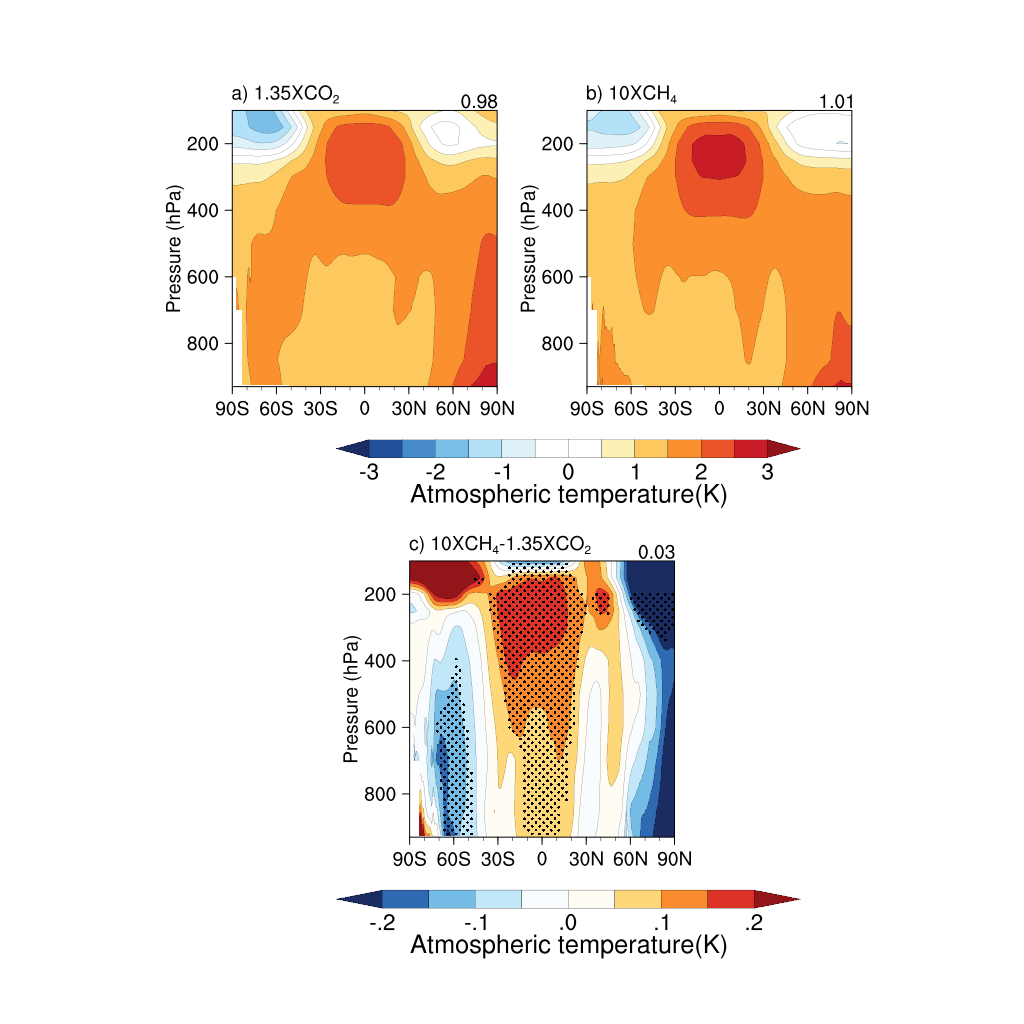
Methane is the third most significant anthropogenic driver of climate change after carbon dioxide and aerosols, contributing about one-fourth of carbon dioxide’s effective radiative forcing in the industrial era. This study compares the slow climate responses to carbon dioxide (CO2) and methane (CH4) radiative forcings by estimating individual climate feedbacks using radiative kernels. We use the National Center for Atmospheric Research (NCAR) Community Atmosphere Model, version 5 (CAM5) and our experiments show that for comparable radiative forcing, methane forcing’s efficacy in the 10xCH4 experiment (0.90) is smaller than the efficacy of 1.35xCO2 (unity). This lower efficacy of the slow response for CH4 owing to its more negative feedback (- 1.08 W m-2 K-1) compared to CO2 (- 0.97 W m-2 K-1) is attributed to differences in lapse rate, water vapor, shortwave cloud, and albedo feedbacks.
→ Related Publication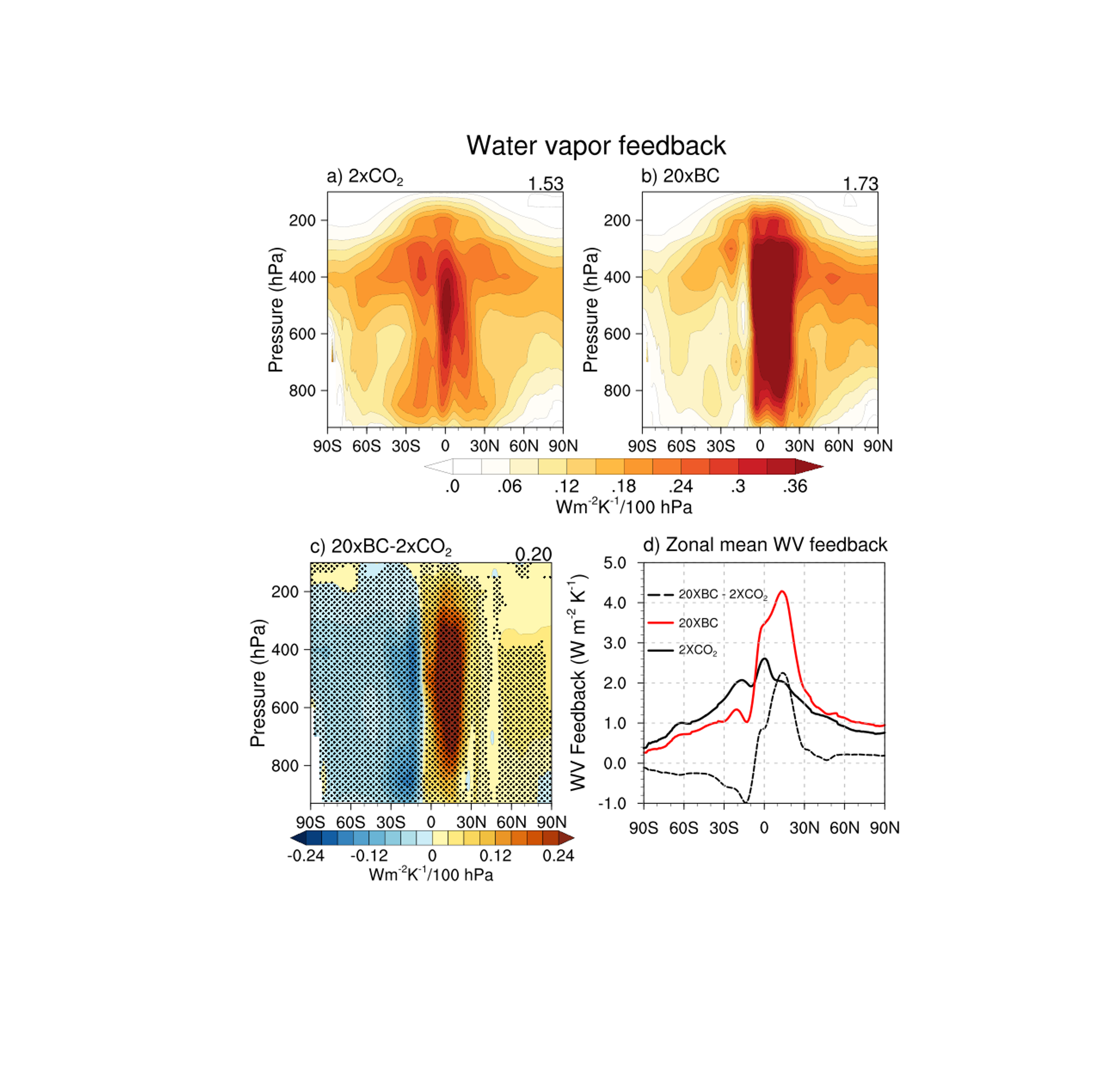
Radiative Kernel Analysis Reveals Weaker Climate Sensitivity to Black Carbon Forcing than to Carbon Dioxide
Black carbon (BC) aerosols perturb Earth’s energy balance through strong atmospheric absorption and associated semi-direct effects, yet the climate response to BC forcing remains uncertain. Here, we quantify the equilibrium climate response to enhanced BC forcing by increasing the BC concentration by a factor of 20 and comparing it to a CO2 doubling experiment using the NCAR Community Atmosphere Model version 5 (CAM5). We find that the warming per unit ERF is smaller for BC than CO2 (~0.6 vs ~0.8 K per W m-2), implying lower efficacy. The lower efficacy is dominated by a sign reversal of the global-mean shortwave cloud feedback (-0.15 W m-2 K-1 for BC versus +0.25 W m-2 K-1 for CO2), linked to hemispherically asymmetric BC heating, a northward ITCZ shift, and associated cloud reorganization that enhances low clouds. The hemipsherically asymmetric BC heating also weakens surface-albedo feedback by limiting Southern Hemisphere sea-ice melt. Further, BC’s top-heavy warming in the fast adjustments makes lapse-rate feedback more negative. Although water-vapor and longwave cloud feedbacks strengthen under BC, they do not offset these damping effects.
→ Related Publication